Triage
Dental emergencies don't arrive on schedule. One patient phones with a swelling that has spread overnight; another walks in with a dull ache they have tolerated for weeks. Both say the same word — "urgent" — and the front desk has seconds to decide which one truly needs a dentist today. VeriPath Dental's triage system does that work consistently, every time, in a way that protects patients and gives the whole team confidence.
Built into the booking workflow, it captures what a patient tells you, sorts every case into a clear urgency tier, and makes sure nothing serious is ever missed.
The reality without triage
Every dental practice knows the failure modes:
- Urgency decided by eye. Whoever answers the phone decides how urgent a case sounds — and that judgement varies from person to person, shift to shift.
- Emergencies buried in the diary. A patient with a genuine problem is booked into the next free slot, alongside routine check-ups, because nobody stopped to ask the right questions.
- Red flags missed. The call that should have ended with "call 999" ends with a routine appointment instead.
- No way to see the queue. When a clinician asks "what urgent cases are waiting?", the answer is a shrug and a scroll through the day.
None of these are failures of care — they are failures of process. VeriPath Dental replaces guesswork with a consistent, auditable workflow.
Every request, checked the same way
When a staff member books an appointment, the symptom checker walks through three short questions, from most to least serious:
| Question | If answered yes | What happens |
|---|---|---|
| Life-threatening? — difficulty breathing or swallowing, swelling spreading towards the eye or neck, uncontrollable facial bleeding | Emergency | Hard stop — never booked. The practice's emergency guidance is shown and the patient is directed to 999 or A&E. |
| Urgent? — severe pain not controlled by painkillers, dental trauma, a localised swelling or abscess | Urgent | Routed into the practice's protected emergency slots, for care within 24 hours, with staff follow-up. |
| Non-urgent? — a lost filling, crown or bridge, broken denture, dull ache, bleeding gums | Non-urgent | A standard appointment within seven days, with clear self-care advice to share with the patient. |
| None of these | Routine | Booked into the ordinary calendar as usual. |
The checker is optional — staff can still type the patient's own words into the symptoms field — but for anything that sounds urgent, working through the tick-boxes means no serious case is decided on a first impression alone.
The hard stop: when "don't book" is the right answer
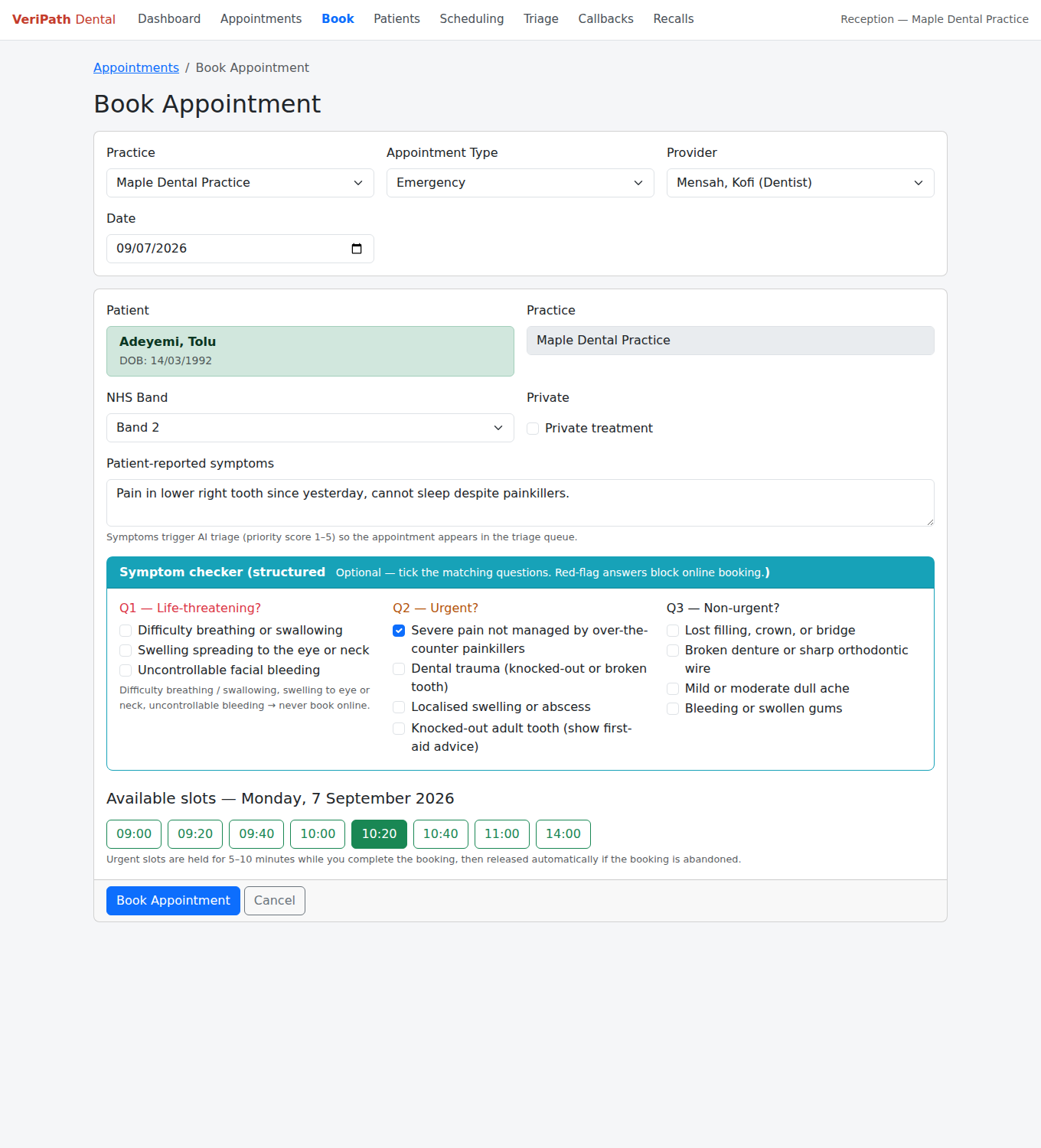
Some symptoms — difficulty breathing, swelling spreading towards the eye or neck, uncontrollable facial bleeding — can be life-threatening. When any of these are flagged, the app blocks the booking entirely. The patient is never given a routine appointment instead of emergency care.
The screen shows the practice's own emergency guidance (which can be configured per practice — a local after-hours number, a preferred A&E, the standard 999 advice). The case is recorded and flagged to a clinician for follow-up. The system makes the safe choice the easy choice, and it does so every time, regardless of who is working the desk.
Urgent care, protected in the diary
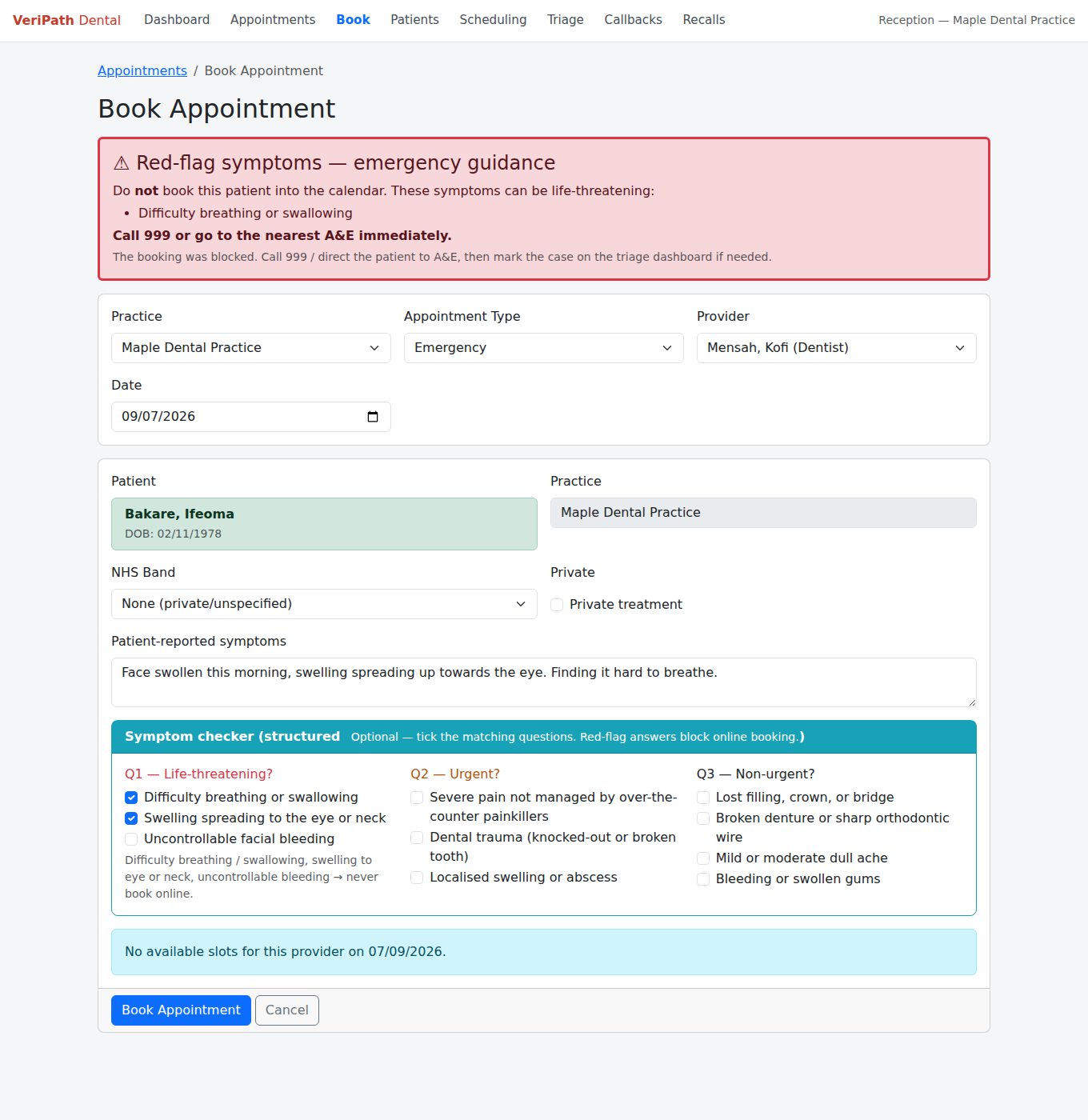
Urgent cases are not left to compete with routine appointments. The practice keeps aside dedicated Emergency zone slots — typically a small number of 20-minute appointments each day, held in red on the slot calendar. When the symptom checker identifies an urgent case, the patient is booked into one of these protected slots for care within 24 hours.
Those slots are held for 5–10 minutes while the booking is completed, so a patient who walks away mid-booking cannot leave an emergency slot locked. If the booking is abandoned, the hold releases automatically.
The triage queue: nothing disappears into the diary
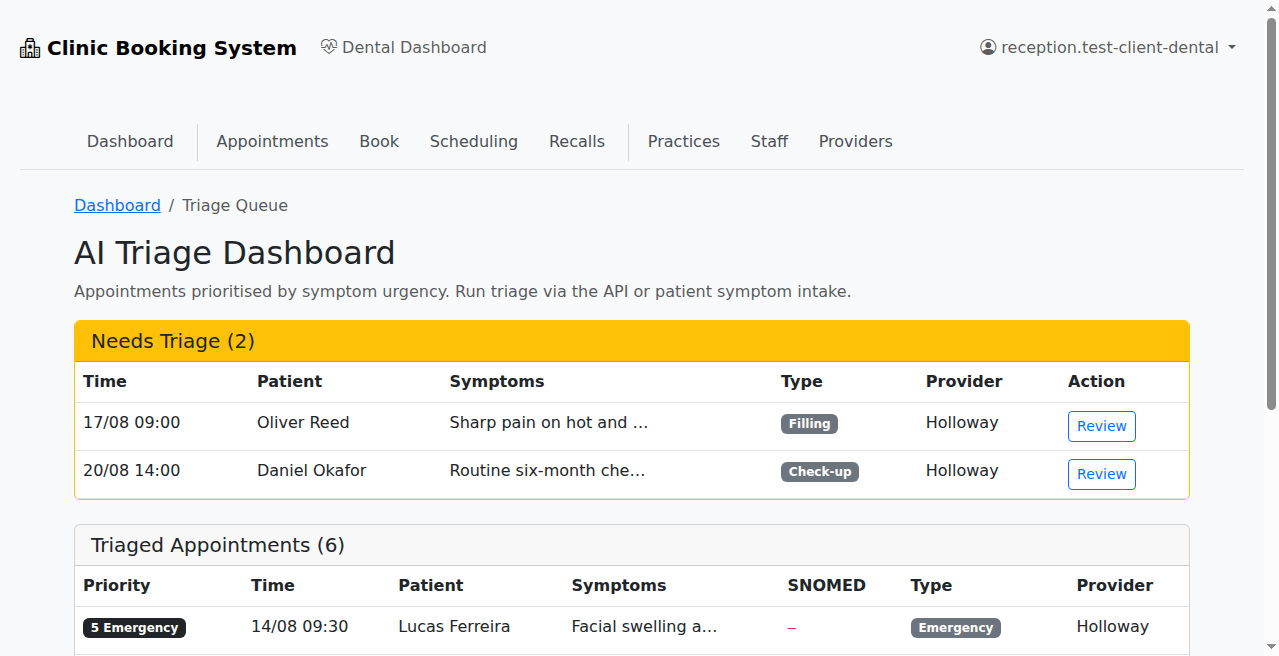
Every appointment that needs a second look lands in the practice's triage queue, where the team can see at a glance:
- the urgency tier for every case, with a clear badge;
- the symptoms the patient reported and the standard clinical code (SNOMED) mapped to them;
- which cases need confirmation before the patient arrives.
From the queue, staff can review a case, re-run the triage, or — where a clinician judges the urgency differently — override the tier with a recorded reason, so the audit trail explains every decision. Once reviewed, the case is marked handled. The queue is the single place where urgent care is tracked from first call to treated patient — nothing sits in a forgotten diary page.
What this means for the practice
- Patients are safer. Life-threatening presentations are caught at the front desk, not discovered later.
- Urgent patients are seen in time. Protected slots and clear timeframes replace "we'll fit you in when we can".
- The team is consistent. Every request is checked the same way, whichever member of staff answers the phone.
- Clinical time is protected. Clinicians see urgent work flagged and ready, with symptoms recorded before the patient even sits in the chair.
- Decisions are auditable. Tiers, overrides and reasons are recorded — useful for governance and for demonstrating safe practice.
- Deterministic by design. Triage runs on transparent rules, not a black box — every tier decision can be explained, traced and defended line by line. That is the right posture for a safety-critical function, and it is exactly what DSPT and CQC evidence reviews look for.
Clinical control stays with the practice
Patients cannot book emergency appointments themselves. The patient app offers a request a callback instead, and the practice's own team runs the same symptom checker when they call back. The front desk — not a patient-facing form — remains the gateway to urgent care.
Part of a connected patient-management workflow
Triage is one part of how VeriPath Dental manages patient care from first contact to treatment:
- Emergency Slot Management — how protected emergency slots and the symptom checker work together to guarantee urgent care within 24 hours.
- Appointment Booking — the screen the checker runs on, and the diary the urgent case is booked into.