Clinical Charting
Every NHS claim the practice sends is priced from a decision someone made at the chair. The band a claim is paid at follows the treatment recorded, so the chart is not only a picture of the mouth — it is the record the money is worked out from, tooth by tooth and visit by visit.
VeriPath Dental records the chart the way a clinician describes it out loud: the standard two-digit FDI system, one entry per tooth, each entry tied to the visit it was recorded at.
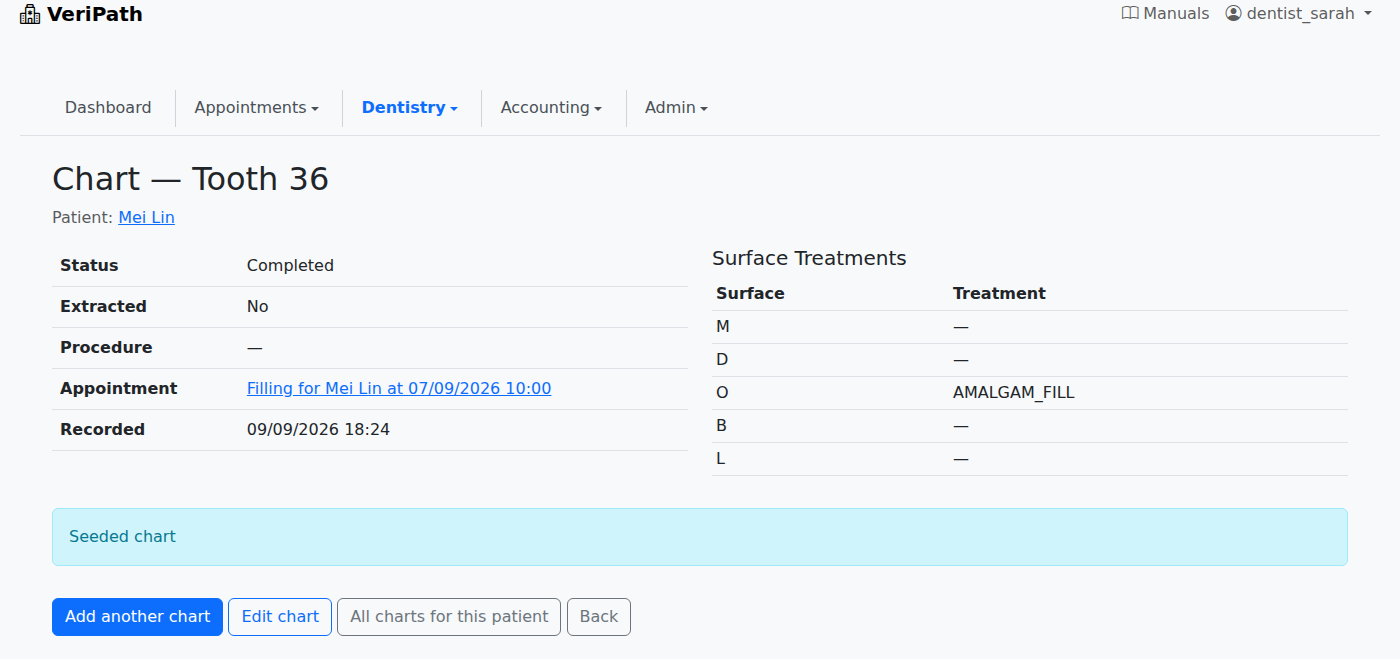
Standard notation, one entry per tooth
Teeth are named by their FDI number — the two-digit convention every dentist already uses, adult teeth 11 to 48 and primary teeth 51 to 85, the first digit giving the quadrant and the second the position from the middle of the mouth. Each entry carries the tooth, its status, the surfaces involved, and the appointment it belongs to, so the record reads the same as the conversation in the surgery.
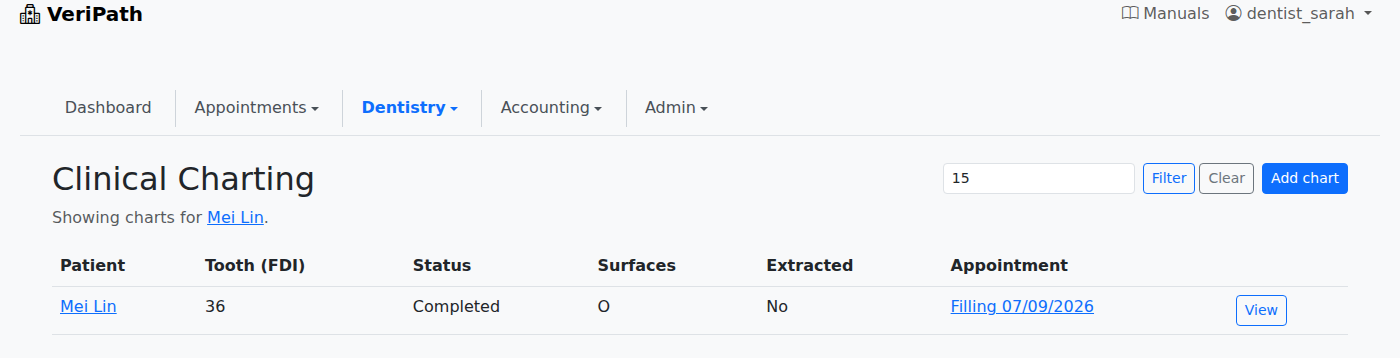
Existing, proposed, completed — the plan lives on the chart
An entry is recorded as treatment already in the mouth, treatment that is planned, or treatment that has been completed. That single distinction is what lets the chart show a patient what is proposed and then show the same chart as the work is done, instead of a flat list of everything ever entered. The patient's plan stops living on a separate sheet of paper and starts sitting against the teeth it concerns.
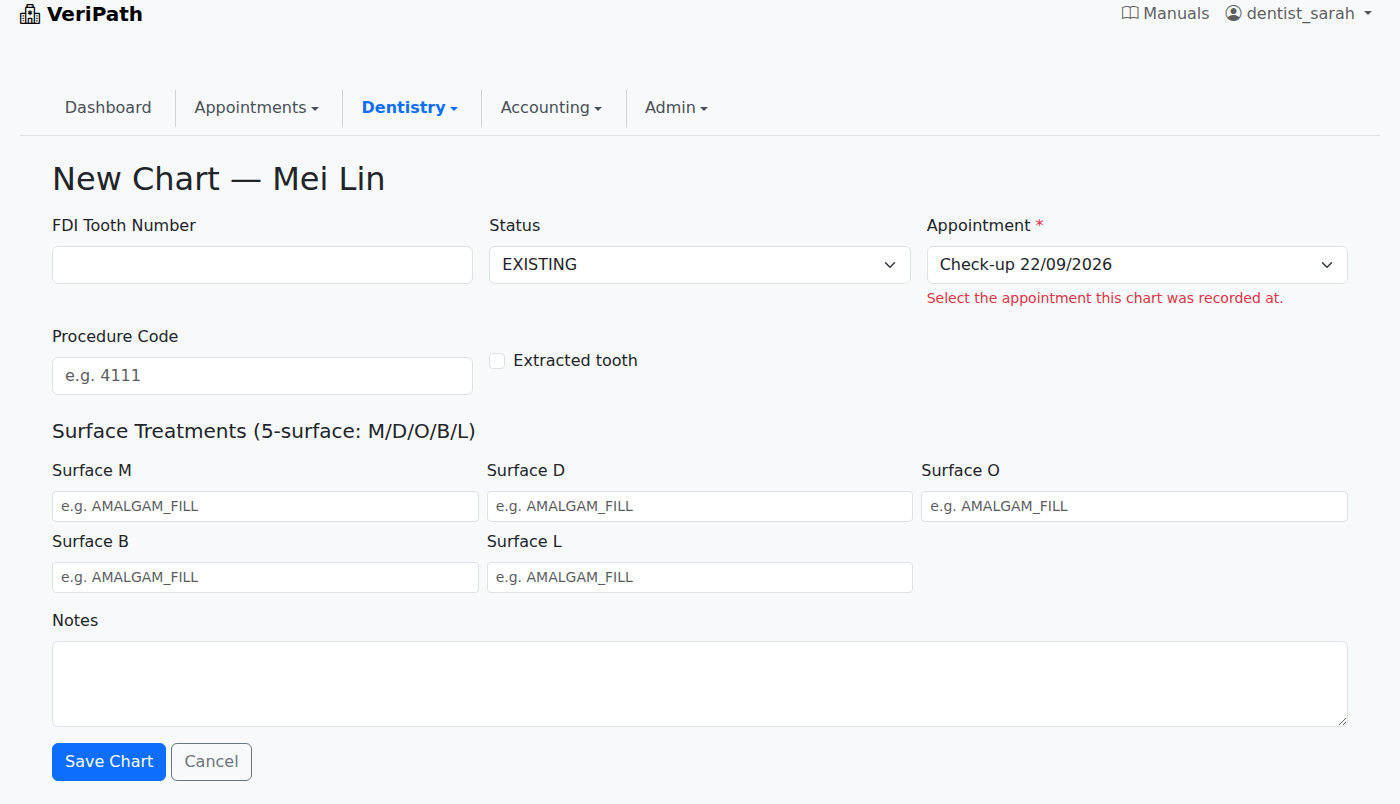
Which surfaces, not just which tooth
A filling rarely covers the whole tooth, so the record goes down to the surface: mesial, distal, occlusal, buccal and lingual, each with the treatment placed on it. A crown on 26, an occlusal amalgam, a distal composite — held at that level, the chart still makes sense to whoever reads it next, and it still stands up when the treatment is queried.
Every entry belongs to a visit
A chart entry is recorded against the appointment it came from, so nothing floats free of the day it was found. An extracted tooth is recorded as extracted rather than left to be inferred from a gap, and the notes that matter — what was proposed, what the patient was told — stay with the tooth they describe. Recording the baseline first is the habit this rewards: put what is already there on the chart at the first visit, and every later change is visible against it.
The chart is where the claim is decided
The band an NHS claim is priced at comes from the treatment completed on the course, and the treatment codes are the ones recorded for the work carried out. That makes the chart the first place a claim is built, not the last. Record the work as it is done and month end becomes a check rather than a reconstruction.
Part of the VeriPath Dental set
- Appointment Booking — the visit the chart entry is recorded against.
- NHS Contract & FP17 Claims — the claim the charted work is priced into.